How to Choose Art for Your Home
The complete guide to choosing the right size, style and placement—and creating rooms that feel personal, layered and collected over time.
Choosing art for a home is one of the most personal decisions in decorating. Furniture gives a room its function. Lighting changes its mood. Textiles soften its edges. But artwork does something quieter and more lasting: it gives the room a point of view.
The right painting can make an ordinary wall feel inevitable. It can connect an antique table with a contemporary sofa, bring warmth to a restrained palette, or give a newly decorated room the sense that it has been evolving for years.
And yet choosing wall art often becomes one of the decisions people postpone. The questions seem deceptively simple. How large should the artwork be? Should it match the sofa? Does every piece in a room need to belong to the same style? Is one large canvas better than several smaller works? How high should artwork hang?
The answer is rarely a formula. The most memorable interiors are not assembled by matching every element perfectly. They are created through proportion, rhythm, contrast and—above all—personal conviction.
This guide is designed to help you choose art with confidence: from scale and placement to color, subject matter and the subtler question of how artwork should feel in a room. If your goal is a home that feels layered rather than decorated, begin here.
What to Consider Before Choosing Art
Before looking for a specific painting, look at the room itself. Not only at its colors, but at its architecture, proportions, materials and existing objects.
A room with high ceilings, generous mouldings and a long sofa may need artwork with enough physical presence to hold the wall. A small reading room lined with books might respond better to intimate works placed among shelves and lamps. A minimal apartment may benefit from a painting that introduces history and softness; a richly patterned room may need art with a calmer visual rhythm.
Think, too, about what the room already says. Is it formal or relaxed? Light or atmospheric? Spare or abundant? The artwork does not need to repeat that character. Often, the most interesting choice is the one that introduces a gentle counterpoint.
Ask what the room is missing
If the space feels cold, look for warmth rather than another neutral object. If it feels overly coordinated, introduce something with age, texture or unexpected color. If the furniture feels visually heavy, an expansive landscape can create distance and air. If the architecture lacks detail, a richly painted canvas can provide the depth the room is missing.
Most importantly, do not begin with the question, “What matches?” Begin with, “What would make this room more interesting to live with?”
Good art does not have to match a room. It has to belong there.
House of Sun EditionsThis distinction is central to the philosophy of a collected home. The goal is not visual uniformity. It is the feeling that every piece has been chosen with enough care to earn its place.
How to Choose the Right Size Art for Your Wall
Scale is one of the fastest ways to make artwork feel intentional. A beautiful piece that is too small for its wall can look isolated. A work that is generous enough in scale gives the eye somewhere to rest and helps anchor the furniture beneath it.
When artwork hangs above a sofa, console, bed or sideboard, a useful starting point is for the artwork—or the complete grouping—to occupy roughly two-thirds to three-quarters of the furniture width. This is not a law. It is simply a dependable proportion from which you can adjust according to the architecture and the visual weight of the piece.
- Above a 90 in / 229 cm sofa, consider artwork or a grouping around 60–68 in / 152–173 cm wide.
- Above a 60 in / 152 cm console, begin around 40–45 in / 102–114 cm wide.
- For very tall walls, consider height as seriously as width; a small horizontal piece can feel lost even if its width is technically correct.
- When in doubt between two sizes for an empty statement wall, the more generous scale often feels more resolved.
Measure the relationship, not only the wall
The relevant measurement is rarely the entire wall. It is the visual zone created by the furniture. A 4-metre wall can still call for a relatively intimate painting if a small desk occupies only one corner. Conversely, a large sectional can demand a substantial work even when the room itself is modest.
Before purchasing, mark the proposed dimensions with painter's tape. Step back to the doorway, sit in the chair you use most often and look again. Scale changes dramatically with viewing distance.
Small artwork can still have presence
Small works are most convincing when their scale feels intentional. Hang one over a narrow bedside table. Rest one on a shelf between books. Pair two related works closely. Or build a group in which several smaller pieces read as one visual composition.
Size should create confidence, not simply fill space.
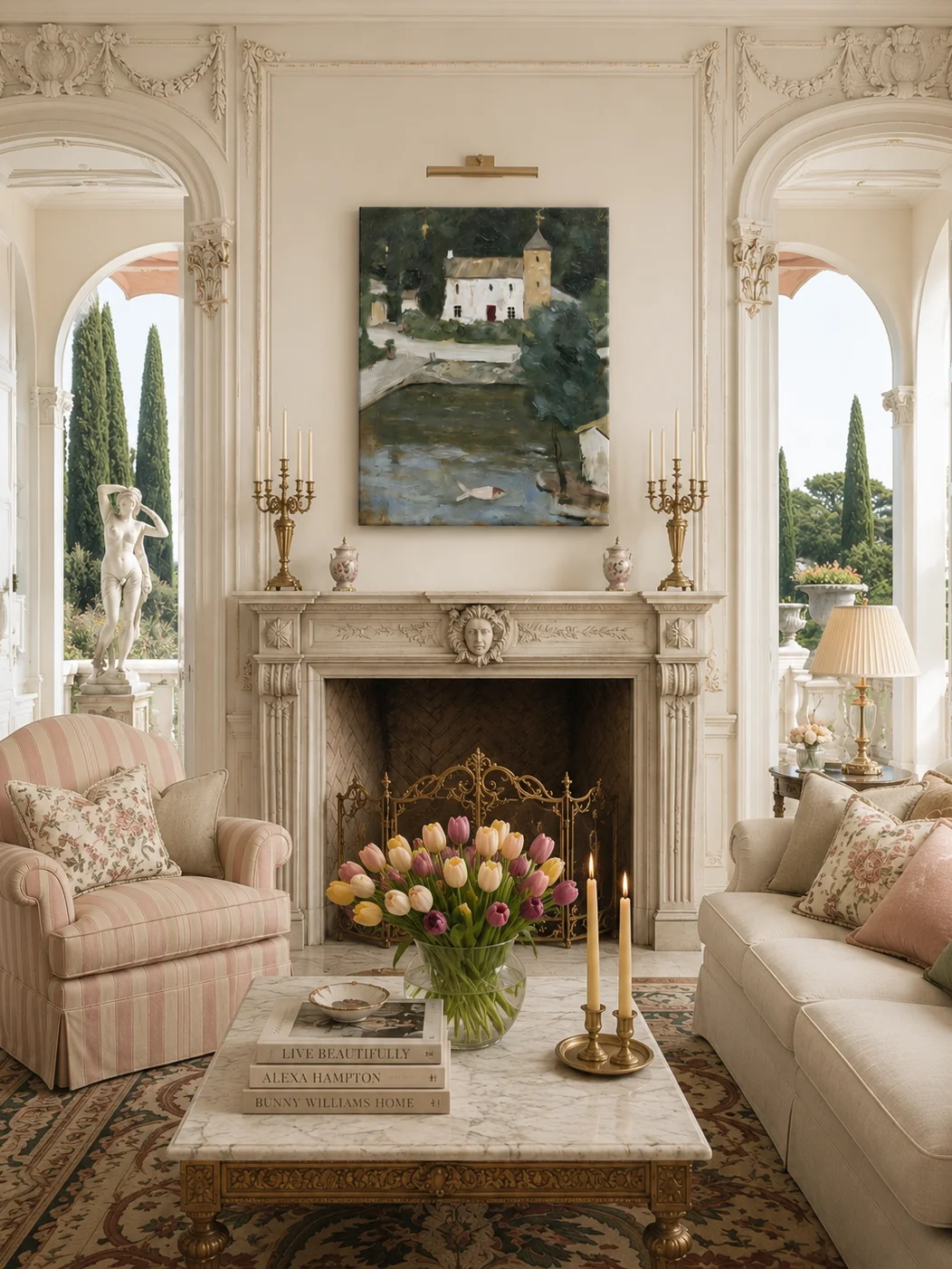
Maison du Lac I
A softly layered landscape in olive, muted blue and warm stone tones—designed to bring calm and understated character to collected interiors.
Shop the ArtworkWhere and How High to Hang Artwork
Artwork should feel connected to the room rather than floating above it. A common gallery convention places the center of a work at approximately 57–60 in / 145–152 cm from the floor. In a home, however, furniture changes the equation.
Above a sofa, headboard or console, start with roughly 6–10 in / 15–25 cm between the furniture and the bottom edge of the artwork. The exact distance depends on mouldings, lamps, the height of the furniture and the proportions of the work. What matters is visual connection.
Let architecture guide the placement
Door frames, fireplace mantels, picture rails, panelling and windows already create lines within a room. Artwork feels especially considered when it responds to those lines. A painting might align loosely with the top of a doorway, center over a panel, or sit slightly lower beside a reading lamp because that is where the eye naturally lands.
Do not automatically center art on the wall
Center it on the composition. If a console sits off-center because of a door, the painting can center on the console. If an armchair and lamp create a reading corner, a small work can belong to that vignette rather than the entire wall.
This is one of the quiet secrets of sophisticated interiors: rooms are composed as a series of relationships, not a collection of isolated walls.
One Large Artwork or a Gallery Wall?
Both can be timeless. The choice depends on the kind of energy you want the wall to hold.
Choose one large artwork when you want calm
A single substantial painting creates authority and breathing room. It is especially effective above a large sofa, fireplace, bed or dining console. Landscapes work beautifully at scale because they create a sense of depth; botanical compositions can bring the garden into the room; a portrait can give an otherwise restrained space a memorable focal point.
Choose several works when you want rhythm and discovery
A gallery wall is naturally more narrative. It rewards looking slowly. The best examples rarely rely on identical frames and mathematically equal spacing. Instead, they establish a visual conversation through recurring colors, subjects, periods or proportions.
Begin with the strongest work, then build outward. Mix portrait and landscape orientations. Allow one or two smaller pieces to interrupt the grid. Keep enough consistency—in frame tones, palette or subject matter—that the grouping reads as intentional.
Try pairs and trios before a full gallery wall
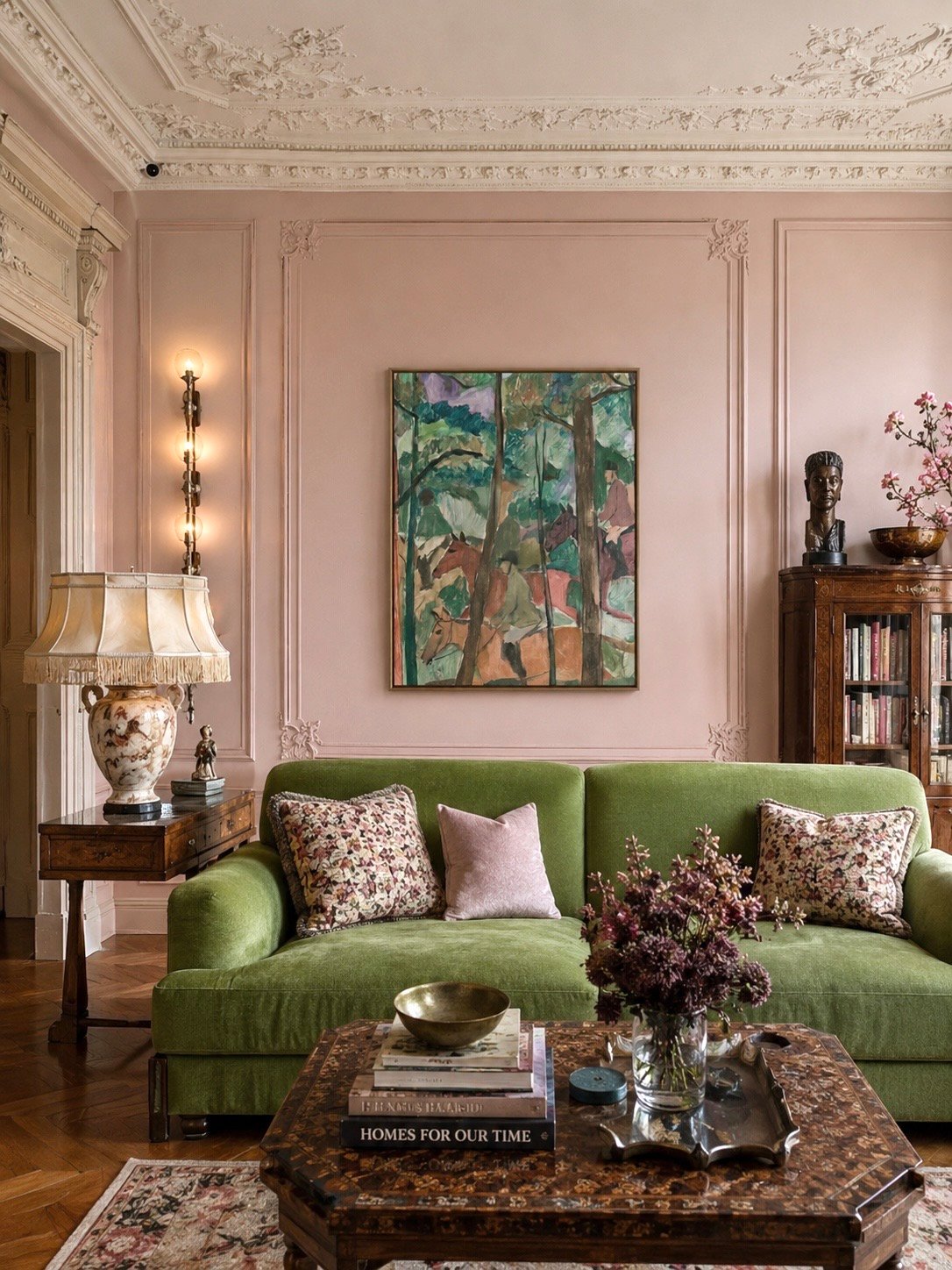
Two related works can be one of the most elegant solutions for a difficult wall. They provide more rhythm than a single piece but remain quieter than a salon hang. A pair of botanical studies, two equestrian scenes or a small landscape sequence can frame a console or create symmetry around a bed.
How to Choose an Art Style for Your Home
The strongest rooms are rarely faithful to one period. A Georgian-inspired interior can hold contemporary art. A modern apartment can be transformed by an old-world landscape. A floral canvas can soften strict architecture. The question is not whether art and furniture come from the same stylistic family; it is whether they create an interesting relationship.
Start by noticing what you repeatedly save, photograph or return to. Perhaps you are drawn to moody landscapes, botanical studies, equestrian scenes, portraits, classical architecture or the visual languages of ancient cultures. Repetition reveals taste more reliably than trends do.
For romantic, garden-led rooms
Botanical studies and floral compositions introduce organic movement and color. Explore the Botanica Collection.
For country & heritage interiors
Equestrian and sporting subjects sit naturally beside leather, wood, checks and tailored upholstery. Explore the Heritage Collection.
For architectural, European rooms
Landscapes, villas and quietly narrative scenes add distance and atmosphere. Explore the Maison Collection.
For eclectic, collector-led rooms
Classical and culturally inspired subjects introduce history and symbolism. Explore the Ancient Worlds Collection.
If you are building a home slowly, you do not need to choose only one of these languages. A collected interior becomes richer when different subjects coexist through a shared sensibility.

Botanical Arrangement I
Layered florals and softly painterly color bring warmth and movement without requiring the rest of the room to match.
Shop the Artwork